Saturday, April 13, 2013

History of Man: Resolving the Timelines part 5

The importance of Egypt

For the history of civilizations, the timeline of Egypt is crucial.  The Egyptians were prolific in their correspondence with other civilizations.  They also traded widely with other civilizations. 

On top of that, six different historians have recorded the history of the Egyptian kings.  They don't agree with each other, and so the dates have seemed to be uncertain over the years.  Historians have based their histories of Egypt primarily on the kinglist of Manetho (c200 BC).  At first, when Manetho's works were first translated, the beginning of Egyptian civilization was dated about 5000 BC.  It has since been reduced to about 3100 BC.  Historians today recognize that further reductions may be necessary, particularly in the time of the third intermediate period.

But the other kinglists are often ignored.  Both the Turin and Abydos kinglists provide helpful information, but because the lengths of reigns are in disagreement with Manetho, historians have discounted their writings.

This is where I want to share my personal story in exploring history.  You need to understand that I, like many of you, I imagine, disliked history in school.  In fact I hated it.  I saw no need for studying all those dates and events.  Now, you need to understand that when I read about the Peloponnesian wars, or the founding of Rome, or other events like that, I remember that I studied them, but you could not make me remember what I learned for the life of me. 

But when I was homeschooling my children, one of the tools I used to attempt to prevent the idea that history was irrelevant was the Book of the Centuries.  But I couldn't resolve the biblical record with the secular record so we just began ancient civilizations and used the accepted dates, realizing there was a problem with them.  No one had attempted to resolve them...yet.

It wasn't until my children were all out of the house that my study took me to the works of a gentleman in Ontario.  His name is Jim Reilly.  Please read his story here.  He had done one of his master's theses on the time of the 26th and 27th dynasties of Egypt.  But he began with scripture.  And he supported a change in the dynastic arrangement of these two dynasties.  For a "blurb" about this event please read the short page here

Edited to add:
Read the following scriptures for some of the prophecy concerning Nebuchadnezzar's destruction of Egypt.

Jeremiah 43:8-13,  44:29-30,  46:25-26
   Jeremiah mostly addressed the Jews who had moved to Tahpenes in Egypt following the fall of Jerusalem in 586 BC.

Ezekiel 30:4-8,  32:3-6,  30:10-11, 13,  29:10-12
   Ezekiel is addressing Egypt itself.

You'll see that with the changes proposed in these two dynasties, the rest of Egyptian history must also be moved to later dates along with the 26th dynasty.  Over the remaining 3 books in his series, he moves the history of Egypt to later dates all the way back to the Old Kingdom of Egypt.  While he did not set out to match the Egyptian timeline to a biblical one, he has successfully achieved that.

And the adjustment of Egyptian chronology has meant that the synchronisms (or correspondences) between Egypt and other civilizations have caused adjustments in those civilizations as well.  And those adjustments did not cause problems, they solved them. 

I continue to study this area...particularly the synchronisms with other cultures...in order to properly date those other cultures.

The "4.2 kiloyear event"

This is a strange time.  In the last 30 years, it has become evident that about 4200 years ago, a climate change began on earth that caused a collapse or near-collapse of almost every civilization in existence at that time.  It began with the end of a Holocene (recent geological time) wet phase...meaning a time of high moisture for a long time...at about 2350 BC on a secular timeline.  Beginning about 2200 BC and for the next 300 years, ending about 1900 BC, there were massive drought conditions.  The evidence shows massive dust and sand storms, the desertification of huge areas of land, and the resulting collapse of the civilizations in those areas.  At the end of this time, there seemed to be a major "chill" that further affected the survival of any civilization, because agriculture was severely affected.

This has become a major area of study for historians, archaeologists, climatologists, and the like, even leading to major world meetings concerning the topic.

Looking at what we have studied before, this event matches the description of the deglaciation period of the ice age perfectly.  But a secular scientist cannot accept that because his deglaciation lasted 6000 years and there was a 9000 year difference in the times on the timeline.

Now the dates being tossed about...2200-1900 BC...are based on the secular timeline.  They are tied to the end of the Egyptian Old Kingdom, the end of the Akkadian Empire, the abandonment of the Harappan civilization, and others.  Those dates will be adjusted to match these events.

Civilizations inundated under the oceans

We'll look at these in more detail later, but in the areas where the earlier civilizations are located, there are also remains of their civilizations under water off the coasts.  None of those remains are any deeper than about 250 feet, in other words, they are on the continental shelf, but they look as if they are a continuation of the civilization on the land.  In every instance the inundation is dated at about 2000 BC. 

Notice the fact that this is the same time as the event we just discussed.  And we said that that event matches the deglaciation period of the ice age.  Well, so does a sea level rise.

Hmm.  Do you see a pattern here?  It appears that these events definitiely match a biblical timeline. 

But they don't match a secular timeline.  Secular historians admit that the sea level rose at the end of the ice age.  But that is 12,000 years ago.  To them this inundation CAN'T be the result of the end of the ice age because there is 8000 years between the two events.  It just isn't possible.  They have to find some other explanation for the massive rise in sea level in 2000 BC. 

Further study

I intend to continue this study.  Some areas that are in line for this are:
  • The bronze age collapse
  • Eruptions of super-volcanoes
  • Dating climate events in scripture

Stay tuned.  Each time I teach this class, I share new information. 

History of Man: Resolving the Timelines part 4

We were looking at the timelines for man's history in part 2 and now it's time to continue with them.  Let's continue the secular story of man.


This timeline begins with the end of the flood and the beginning of the ice age.  To a secular scientist that means from about 2.5 million years ago to about 12,000 years ago.  This is the start of the Paleolithic ... the Old Stone Age.  Homo sapiens hasn't come about yet, but the closest ancestors of man are present and are using crude stone tools.  Homo sapiens, or archaic humans, appeared about 500,000 years ago and modern man, or Homo sapiens sapiens dates from about 200,000 years ago.  During this time the skills in making stone tools develop.


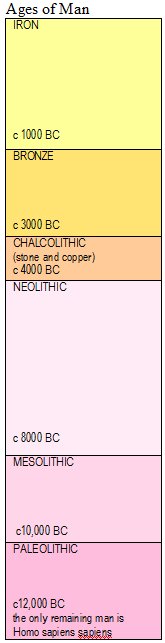
This timeline begins at the end of the ice age and takes us to modern day man.  At the end of the ice age, about 12,000 years ago, modern man is the only remaining Homo species left.  Man still uses stone tools but his skills are advancing.  He begins to develop agricultural skills and makes pottery.

About 4000 years ago he discovers how to work copper and after 1000 years, learns how to alloy that with tin to make bronze.  By this time he lives in villages and cities and is pretty much settled.  The first major civilizations appear about 3200-3000 BC.   It is only about 1000 BC when he discovers how to work iron.

Needless to say, this story of man and the biblical story of man don't agree.  We saw that cities were something that were an early development, with Cain being the first to build a city.  We also have a shorter time line in general.  This timeline requires a very slow development of man's skills and learning.  And that doesn't agree with scripture.

So how are we going to reconcile this picture with what we read in the Bible?  This period of time is more difficult... not because the evidence is scanty, but because it is more readily available.  The problem comes because events are not in the same order in the two timelines.  Let's see if I can give you a visual for what I mean.


Here's the two timelines.  (The secular one on top is not to scale, by the way.)  Both begin with the beginning of the ice age and end in 1000 BC.  This is roughly the time of David and is a time when the two timelines agree, at least to within a few years.

First, notice the ice age.  The secular timeline on top has the ice age beginning 2.5 million years ago and ending 12,000 years ago.  The ice age peak is marked...it's about 18,000 years ago, by the way.  The biblical timeline is similar but has different dating.  It began about 2519 BC and ended about 900 years later.  The peak was at about 1800 BC. 

At the peak of ice volume during the ice age the sea levels would be at their lowest.  At the end of the ice age, the sea level would have risen to its current levels.  Both events are marked on both timelines.

The biblical timeline is marked with the Tower of Babel and the subsequent beginnings of civilizations.   The secular timeline is also marked with the beginnings of civilizations.

Here is where you see the major difference.  Notice that civilizations begin nearly 9000 years after the end of the ice age in the secular timeline, while the biblical timeline has civilization beginning during the ice age. 

Even with no additional evidence being presented, these two timelines give a totally different picture of the history of man.  At this point we can ask the following questions (Do you remember the questions we asked when evaluating the accuracy of a model...way back when we were talking about the flood?  Those same questions can be asked here as well.)
  • Does the biblical timeline explain the evidence better than the secular timeline?
  • Does the biblical timeline require less assumptions to support its validity?
  • Does the biblical timeline allow us to make predictions as to what we would find in future evidences?  Have there been any accurate predictions made in the past?

We will now begin to look at evidences.  First it will be evidences that the timeframe for the beginnings of civilizations needs to be changed.  Then we will begin to explore the evidence that man has left behind.  Prepare to have your paradigm for man's history challenged!

Thursday, April 11, 2013

History of Man: Resolving the Timelines part 3

In the history of man according to secular scientists, man has developed from primitive man to more advanced man.  When he discovered that he could use stone and make tools to make his work easier, that was the beginning of the stone age.  He used stone for a long time, always refining his skills through experimentation.  Then sometime, somehow, he learned that it was possible to make better tools out of metal.  For a time he continued using stone but experimented with copper, later learning how to blend that copper with tin to make bronze.  Still later he learned about iron and the superiority of that metal for his tools.  We still use iron and its alloys today.

To me this all seems a bit fantastic...kind of like evolution is fantastic.  A fairy tale. 

How did man "discover" all of this?  Metal fabrication is a complex process requiring the high temperatures of smelting furnaces, not the simple campfire.  And the different metals required in making alloys are rarely found together or even near to each other.  Those deposits are scattered in different locations.

Regardless of the fantasy of "discovery"... here is the scheme for the Ages of Man:


THE AGES OF MAN

Archaeologists divide the history of human occupation into three main ages…the stone age, the bronze age, and the iron age.  These are based on the types of tools used by the various peoples involved.  Please realize that these divisions are only a convenience that serves as a diagnosis of date.  Even then, the dates vary in different parts of the world.  Other factors figure in to the growth of human civilizations…including:
  • Social organization
  • Food sources
  • Adaptation to climate
  • Agriculture
  • Cooking
  • Settlement
  • Religion

Any arrangement of human society in an archaeological chronology reflects the difficulty of manufacture of the tools and weapons used by that society.

Stone Age

  • This is the period of time when stone was widely used to make implements with a sharp edge, a point, or a striking surface.
  • The earliest stone tools were found in rock layers that are dated to just before the ice age begins. 
  • During the stone age, man supposedly developed agriculture and began to settle in villages and later in cities.
  • Also during the stone age, man supposedly developed the production of pottery.
  • The stone age ends in any location when a culture develops the use of metals for tools
  • Some societies are still stone age today
  • Unfortunately, this designation allows for the implication that stone age people were some earlier stage of human development.

Bronze Age

  • This is the period in man’s supposed technological advancement when he has learned to work with copper and to alloy copper with tin to make bronze to make weapons and tools.
  • The date that different civilizations developed this technology varies with location, and some areas of the world appear to have skipped the use of bronze altogether and went straight from stone to iron.
  • It appears that the Bronze age ended in a major collapse of civilizations world-wide.

Iron Age

  • This is the period of time when iron was used to make tools and weapons.
  • We are in this age today.

The idea for these ages are ultimately derived from the Ages of Man , the stages of human existence on the earth according to Greek mythology.  See this article: http://en.wikipedia.org/wiki/Ages_of_Man
What is interesting about the different ages is that there seems to be a remnant of the biblical story of man in this tale. 


History of Man: Resolving the Timelines part 2

We are going to take a look right now at a secular "history of everything" timeline and begin this reconciliation of timelines.


This first timeline shows us the beginnings of the universe at 13.7 billion years ago and the shaded portion is all of the events that take place up to the beginning of the earth at 4.5 billion years ago.  During this time all of the stars and galaxies come into existence.

The secular scientist bases his dating of this period on:
  • the date the earth begins
  • astronomy and astrophysics
  • microwave background radiation
  • temperature of the coolest white dwarf star
  • red shift
  • expansion of the universe

In a biblical understanding of beginnings, these events would have taken place on day 4 of creation week.

Genesis 1  14 Then God said, “Let there be lights in the expanse of the heavens to separate the day from the night, and let them be for signs and for seasons and for days and years; 15 and let them be for lights in the expanse of the heavens to give light on the earth”; and it was so. 16 God made the two great lights, the greater light to govern the day, and the lesser light to govern the night; He made the stars also. 17 God placed them in the expanse of the heavens to give light on the earth, 18 and to govern the day and the night, and to separate the light from the darkness; and God saw that it was good. 19 There was evening and there was morning, a fourth day.


This second timeline shows the time from the beginnings of the earth to the beginnings of life.

The secular scientist bases his timeline on:
  • uniformitarian principles of geology
  • radiometric dating of crystals found deep in the earth
  • dating of meteorites
  • dating of moon rocks

This is days 1-3 of creation week on a biblical timeline.

Genesis 1  1 In the beginning God created the heavens and the earth. 2 The earth was formless and void, and darkness was over the surface of the deep, and the Spirit of God was moving over the surface of the waters. 3 Then God said, “Let there be light”; and there was light. 4 God saw that the light was good; and God separated the light from the darkness. 5 God called the light day, and the darkness He called night. And there was evening and there was morning, one day.

6 Then God said, “Let there be an expanse in the midst of the waters, and let it separate the waters from the waters.” 7 God made the expanse, and separated the waters which were below the expanse from the waters which were above the expanse; and it was so. 8 God called the expanse heaven. And there was evening and there was morning, a second day.

9 Then God said, “Let the waters below the heavens be gathered into one place, and let the dry land appear”; and it was so. 10 God called the dry land earth, and the gathering of the waters He called seas; and God saw that it was good…. 13 There was evening and there was morning, a third day.


The remainder of the week of creation, from the remainder of day 3 through day 6 tells of the origin of every form of life on earth.

And the first few chapters of Genesis tell us of the first 1656 years of life on earth.  Man multiplied...man built cities...man developed technology...man became evil...and God determined to destroy the earth and all of its life as man knew it, preserving only a few individuals to begin again. 

And so we come to the next timeline of history...


This timeline starts with the beginnings of life and goes to the beginning of the ice age and the early so-called ancestors of man. 

The secular scientist bases this timeline on
  • uniformitarian principles of geology
  • radiometric dating
  • fossil record
Unfortunately for them, dating rocks by the fossils and fossils by the rock layers is circular reasoning, and is totally invalid.

This is not slow processes and evolution we see in this timeline, but the record of the destruction of all of pre-flood life.  The fossils in this record begin with those that would be buried first in the flood...the sea-bottom dwellers...and ends with those who had the greatest ability to escape the rising flood waters (at least for a time).  These are flood deposits.  Any records of pre-flood civilizations would be found in these layers of rock, like we find the animals who lived in the pre-flood times, or would be found "undisturbed" in pre-cambrian layers.

To really get an understanding of the tremendous amount of destruction we are dealing with in the flood, go back to the posts on the flood and re-read them, particularly going to the link for the hydroplate theory of the flood.

To be continued in the next post.

History of Man: Resolving the Timelines part 1


We have now come up against a roadblock.
  • Secular scientists have a timeline that's 13.7 billion years long.
  • We have a timeline that is 6188 years long.
Quite a difference!  And there doesn't seem to be an easy way to get the two to meet.  Why?
  • We have scripture
  • They have dating methods that seem to be reliable.

But in truth, the dating methods are rarely reliable.

DATING METHODS

Here are some of the most obvious dating methods that are used to obtain dates for geologic history (in no specific order):
  • Radiometric dating other than radiocarbon dating.
  • Ice cores in Greenland and the Antarctic.
  • Dendrochonology (tree ring dating).
  • Stratigraphy
  • Fossil record
  • Written texts and coins
  • Radiocarbon dating

Then these dating methods are used by
  • Geologists, physicists, and chemists
  • Archaeologists
  • Paleontologists and palnyologists
  • Paleoanthropologists
 
…and unfortunately they sometimes don’t agree.

Scientific research works in the present on evidence that exists in the present.  Any conclusions about the past MUST rest on assumptions.  All dating methods are based on these assumptions.  Some have more than others.  Let’s look at the different methods and check their validity.  I will give you the major assumptions that are made for each one, and at least one example of evidence dated by those methods that is known to be incorrect.

Radiometric dating
Used to date igneous rock
Uses radioactive decay for the measuring tool
Types: U-Pb (two types), K-Ar, Rb-Sr, and Sa-Ne
Assumptions:
  • Heat forced all the daughter element out of the molten rock
  • Once the molten rock cools, no more daughter element escapes
  • Initial conditions are known
  • Amounts of parent and daughter elements have only changed because of decay
  • Rate of decay remains constant.
Usually yields dates of millions of years, sometimes billions of years
Examples of known dating errors:
  • Lava flows from Mount St Helens (1986) dated at 350,000 years
  • Lava flows from Mount Ngauruhoe, NZ, (less than 50 years ago) dated at 3.5 million years

Radiocarbon dating
This is a type of radiometric dating that measures decay of C to N and has narrow uses
Can only be used on items that were formerly living…wood, baskets, bone (not fossilized), etc
There is a limit to the accuracy of this method because of the extremely short half-life of C14.
Assumptions
  • The same as other radiometic dating methods
  • Influx and outflow of C14 in the biosphere is in equilibrium
Examples of known dating errors
  • Two separate samples of a single dinosaur bone dated at 9890 years and 16,120 years
  • Freshly killed seal dated at 1300 years
  • Living penguin tissue dated at 8000 years

Ice Cores
Layers of ice are seen in Greenland and Antarctica
Assumptions
  • Ice has been there for as much as 2.5 million years
  • Layers are annual layers
  • Precipitation rates are similar to today’s
Examples of known dating errors:
  • Two World War II planes that crash landed on Greenland were located 250 feet deep in ice.  If ice were to accumulate 250 feet in 50 years, then the entire Greenland ice cap would be less than 1000 years old.

Dendrochronology
Used to supplement radiocarbon dating and “correct” its dates.
Uses tree ring counting to determine date the tree was cut down.
Tree ring width is determined by weather conditions.
Begins with the C14 date
Assumptions
  • Trees put on one ring per year
  • One can use the tree ring patterns from trees of one region to overlap and match those from another region
  • Radiocarbon dating is accurate
Examples of known dating errors:
  • A wooden building from Dalecarlia, Sweden, was dated as being built in about 1240, and refurbished in the 1490’s, 1570’s and 1930’s.  Yet a wooden building in that climate cannot last that long.

Stratigraphy and the Fossil Record
This method defines layers of sedimentary rock, and identifies the fossils present
Certain layers of rock contain particular fossils that are in no other layers.  These are index fossils.
Assumptions
  • Sediments were laid down at the same rate in the past as they are today.
  • Sediments were laid down slowly
  • Index fossils are used to date rock layers
  • Rock layers are defined by the index fossils
  • Evolution is true
  • Uniformitarianism is true
Examples of known dating errors
  • Man-made artifacts in layers that predate the supposed appearance of man

Artifacts and Inscription Evidence
These are dated much the same as fossils, although this evidence is in much shallower levels. 
Some artifacts can be dated by C14 dating…for example, basketry, leather clothing, papyrus documents, etc
Assumptions
  • Preconceived notion as to the supposed evolution of man
  • Preconceived notion as to the Stone Age, Bronze Age, and Iron Age dating for certain areas
Problems exist with this evidence, because if a new finding disagrees with the presuppositions, evidence is often discounted (or discarded!)

 
It is the commitment to
  • a big bang origin of the universe
  • and old earth, and
  • evolution
that determines how secular scientists choose to date history.  For as many dating methods as give ages of millions or billions of years, there are as many that give dates under 10,000 years, and some of those are as short as 150 years!  We know that the earth is older than that!  Obviously, there are problems with these methods and care should be exercised in relying on them.
 
What we want to do is attempt to reconcile the differences between these two timelines.
 
I once got a comment that it would be nice to have a "cheat sheet" card that gave a conversion table for the dates so that when one was reading a book and it said "x-number of years," there would be a way to convert that to a biblical time scale.  It's not quite that simple, but this will be our goal...to get as close to that as we can.

Saturday, March 30, 2013

The Ice Age


What does the worldview of naturalism tell us about the ice age(s)?
  • Secular scientists tell us that there were five periods of ice, but only the last appears in mankind’s history.  It is considered to be one ice age with multiple glaciations.  The ice advanced and retreated as many as 40 times.  This is the Pleistocene era on your geological time scale chart and it supposedly began about 2-2.5 million years ago, reached a peak at about 18,000 years ago, and ended about 10,000-12,000 years ago.
  • The ice age caused a lot of water to be tied up in ice, lowering the sea level dramatically.  When the ice melted, then the sea level rose
  • The cause of the ice age is global cooling with lower temperatures at the earth’s surface and in the atmosphere.

There is no question that ice once covered large parts of North America, northern Europe, and northwest Asia, as well as areas of mountains where no ice exists today.  The evidence is there.  But secular scientists have presented no satisfactory theory that accounts for this history of glaciation that is evident on earth.

What is needed is to look at the evidence with different eyeglasses, to use different assumptions, and thus get a different interpretation of the evidence. 

But first we need to determine what conditions are needed in order develop an ice age.  Surprisingly, secular and creationist scientists now agree on the climate change that is needed to produce and maintain ice sheets.
  • Snow must survive the summers
  • Enough snow has to fall in the winter to survive to the following year.

Next we need to determine what circumstances might allow these conditions to exist.
  • Warmer oceans would cause greater evaporation and hence greater precipitation.
  • Cooler continents encourage snowfall.
  • Reducing the amount of sunlight reaching earth’s surface by volcanism, greater cloudiness, or reduced carbon dioxide levels.
  • Reflect more of the sunlight off the earth’s surface into the atmosphere.

Because these circumstances cannot be found in the uniformitarian, secular view of science and history, we must look for a time of catastrophe that gives us these circumstances…and that is after the flood.
  • The floodgates of heaven and the fountains of the great deep added huge amounts of warm water to the existing seas, leaving a nice warm ocean.
  • The continental land masses that emerged from the waters of the flood were barren which would cause greater reflection of the sun’s radiation once the snow begins.
  • Volcanism was a major feature of the late flood times and the times soon after the flood.  This left large amounts of dust and gasses in the atmosphere.
  • While volcanoes add carbon dioxide to the atmosphere, those levels would rapidly drop as a new equilibrium is developed between the atmosphere and the oceans.
  • Winds begin as the continents are exposed, and the storm tracks are established.

Now everything is set up for the beginning of an ice age caused by the Genesis flood.  The higher latitude continents will experience the first snow.  This will happen to the north of the storm tracks and in mountainous regions.  Lowlands near the warm oceans remain ice-free.

As the ice age progresses:
  • Volcanism decreases.
  • Oceans cool as circulation begins.  Surface water cools and sinks.  Warmer water rises to the surface, cools, and sinks.  As this circulation continues, the overall ocean temperature drops.
  • Snow develops over large areas all at one time, rather than in small areas that spread out.
  • Snow and ice builds up and extends further.  The climate of the time is unexpected (at least to us…to a meteorologist it would be expected.)  Winters would be warmer than today and summers cooler.  Ice sheets experienced a temperate, wet climate, and would move quickly.
  • East Asia remains ice-free because of a combination of warm oceans, storm tracks, and geography.
  • The regions south of the ice sheets, under and south of the storm tracks, experienced wet climates with heavy precipitation.  There is extensive evidence for this, including plant and animal remains.  Today these regions are largely desert.  Under the sands of the Sahara are lake and river beds that indicate rainfall hundreds of times greater than today.  In our area of the high great plains, precipitation was likely three times greater than today.
  • As more water is tied up in ice, the sea level drops.  This is compounded by the fact that the continental land masses were still rising  (As a matter of fact, they still are today.)
  • In the areas where large ice sheets develop, the land underneath is pushed back down by the weight of the ice, reducing the net drop in sea level for those areas.

Glacial Maximum is the time when the snow and ice reached its maximum total volume
  • Sea level would be at its lowest.  This would be about 200-300 feet lower than today.
  • Ice depth would be at its greatest  This would be about 2150 feet in the northern hemisphere and 3700 feet in Antarctica.
  • Ocean temperatures would have cooled dramatically to temperatures close to today’s.

I have to be honest here…the calculations and formulas used to estimate the time to reach this point are far too complex for me to understand, let alone be able to be coherent in communicating them to you.  So you just get the results. ;)  But that’s all you want to hear anyway, right?

The range of time to reach glacial maximum would be 174 to 1765 years.  Using reasonable figures for the variables in the formulas tells us that 500 to 700 years would be a reasonable estimate for the time it takes to reach glacial maximum.

De-glaciation occurs when all of our circumstances that built ice are gone. 
  • Ocean temperatures are close to freezing at the surface, less evaporation occurs, less clouds form, hence…the ice sheets begin to melt. 
  • We also see a change in climate.  Winter temperatures get colder, summer temperatures get warmer, storms are windier and drier. 
  • As a result, the Arctic Ocean begins to freeze.
  • Also as a result, the areas south of the ice sheets begin to dry, and deserts begin to form.
  • Greenland and Antarctica will retain their ice sheets.  Altitude, latitude, storms, and proximity to moisture will maintain those ice sheets.
  • As melting occurs, the sea level would rise by 200-300 feet.
  • The land previously covered by ice would rebound upward as the weight of the ice is removed. (As a matter of fact, Canada is still rebounding today.)  The NET change in sea level in the areas that were covered by ice is about 100-125 feet higher.

The time required for de-glaciation is similarly short…only 200-300 years would be required to completely melt the ice.

 
Have I surprised you a bit?  I know I was more than surprised!

 
Why does this disagree so dramatically from the naturalistic worldview?
  • Their time estimates for the latest glacial period is about 2 to 2.5 million years long.  But their estimates are based only on their expanded time frame not on any physical principles.  The math and science of building the ice sheets cannot sustain the idea of 2 million years.

What about mammoths and mastodons and saber-tooth tigers?  They all appear to become extinct at this time.
  • They weren’t killed in the flood because they aren’t in flood deposits.
  • They didn’t die in the ice age because of cold temperatures because the glacial time wasn’t that cold.
  • They actually thrived in the ice age because the climate was wetter with milder winters.  The fossils of the animals found living with these animals (like hippos and rhinos and alligators) confirms this.
  • But when the ice sheets began melting and the arctic began freezing and the storms got drier and windier…
  • The climate cooled dramatically and quickly.  This condition is called The Big Chill.
  • These large animals were stressed by these conditions.  Many escaped, some didn’t.

Recommended reading

Frozen in Time by Michael J Oard (available in a couple of weeks in the church library, or can be read online at www.answersingenesis.org/articles/fit )          

An Ice Age Caused by the Genesis Flood by Michael J Oard (technical, but you can skip the technical equations parts and just read the rest…it’s not difficult reading)


The Table of Nations part 4


The Nations of Ham

Ham  The father of the Hamitic nations.  A historian of several hundred years ago commented that Ham and his family were nomads, and that they ignored the true worship of God and invented heathenism, worship of false gods and of Satan.

Sons of Ham
  • Cush  The name of Cush (rendered Chus in Josephus) is preserved in Egypt’s hieroglyphic inscriptions as Kush, and refer to the country that lays between the 2nd and 3rd cataracts of the Nile.  Josephus notes that Cush ruled over the Ethiopians and that they are called Cushites.  The land was later known as Nubia.  Additional information on this location is gleaned from the records of Esarhaddon, king of Assyria (681-668 BC), who tells us that he made himself king of Musur, of Paturisi, and of Cush.  Some have claimed also that the name of Cush was perpetuated in that of the Babylonian city of Kish, one of the earliest cities to be built after the Flood.
  • Mizraim  A collective name, these people settled in Egypt.  Modern Israelis still use the name for that country.  It is preserved as Msrm in the Ugaritic inscriptions; as Misri in the Amarna tablets; and in the Assyrian and Babylonian records as Musur and Musri respectively.  Modern Arabs still know it as Misr.  Josephus (rendering the name Mesraites) relates that in the Ethiopic War, a well-known incident of the ancient world, some six or seven nations descended from the Mizraim were destroyed.  He lists these as the Ludim, the Anamim, the Lehabim, the Naphtuhim, the Pathrusim, the Casluhim, and the Caphtorim.
  • Put  The country where his descendants settled lies in the proximity of Cyrenaica, on the North African coast west of Egypt.  An inscription in the archives of Darius the Great, king of Persia (522-486 BC) confirms their location.  Egyptian records render the name Put or Punt; Josephus renders it Phut.  This land was known as Puta to the Babylonians and as Putiya in Old Persian inscriptions.
  • Canaan  The descendants of Canaan settled in the land that was later to be given to Israel.  At the time of the Israelite conquest of Canaan, the population consisted of all the tribes descended from Canaan.  The Greeks and Phoenicians rendered the name Kna’an, the Egyptians Kn’nw and Kyn’n.w. The Assyrians rendered the name Kinnahu and the Hurrians described certain dyed cloths as Kinahne or Canaanite cloth.  In spite of their Hamitic descent, however, the Canaanites spoke a Semitic language.

Sons of Cush
  • Sebah  He founded the nation that was later known as the Sabaeans.  Strabo writes of their city of Sabai along with its harbour of Saba, which lay on the west coast of the Arabian peninsula.  Josephus has the same spelling.
  • Havilah   This is the Hamitic tribe of Havilah, not to be confused with the Semitic Havilah.  His descendants settled on the east coast of Arabia looking out onto the Persian Gulf.  Their land was known to the pre-Islamic writers as Hawlan, and to Josephus as Evilas.  Kautsch renders the name as Huwailah, and confirms the location of settlement.
  • Sabta  Josephus records the name of his descendants as the Sabteni or Sabathes.  Ptolemy knew them as the Saptha, and Pliny called them the Messabathi.  They settled on the eastern side of the Arabian peninsula.  Sabta’s name is also preserved in that of the ancient city of Shabwat (modern Sabota), the capital of the Hadramaut.
  • Raamah  We know from the inscriptions of ancient Sheba that Raamah’s descendants settled near to the land of Havilah, and to the east of Ophir.  They are known from other sources to have traded with the children of Zidon in the city of Tyre.  Ptolemy agreed with the Septuagint in the name Ragma, which Josephus rendered Ragmas.  There is still a place called Raamah near Ma’in in southwest Arabia.
  • Sabtecha  Identified by Josephus s the Sabactens or Sabactas, his descendants appear to have settles in southern Arabia, the modern Yemen.
  • Nimrod  Nimrod was undoubtedly the most notorious man in the ancient world who is credited with instigating the Great Rebellion at Babel, and of founding the very worst features of paganism, including the practice of magical arts, astrology, and even human sacrifice.  Moreover, there is much evidence to suggest that he himself was worshipped from the very earliest times.  His name, for example, was perpetuated in those of Nimurda, the Assyrian god of war; Marduk, the Babylonian king of the gods; and the Sumerian deity Amar-utu.  Nimrod was also worshipped by the Romans under the name of Bacchus, this name derived from Bar-Cush, the son of Cush.  A mountain not far from Ararat has been called Nimrud Dagh (Mount Nimrod) from the earliest times and the ruins of Birs Nimrud bear the remains of what is commonly reputed to be the original Tower of Babel.  The Caspian Sea was once called the Mar de Bachu, or Sea of Bacchus.  One of the chief cities of Assyria was named Nimrud, and the Plain of Shinar was itself known as the Land of Nimrod.  Iraqi and Iranian Arabs still speak his name with awe.

Sons of Mizraim
  • Ludim  Seemingly known in later records as the Lubim (which Josephus rendered Ludieim) this people settled on the north coast of Africa and gave their name to the land of Lybia.  They are known to have provided Egypt on more than one occasion with mercenary troops.  The records that tell us this give the Ludim’s name as Lebu.  Otherwise, Josephus records their defeat in the Ethiopic War.
  • Anamim  Few occurrences of this name can now be found in the surviving records.  This may be due to the devastations of the Ethiopic War.  However, the Assyrian king, Sargon II, does tell us in his inscriptions of the land of the A-na-mi which lay adjacent to that of Kaptara.  Josephus rendered the name Enemim.
  • Lehabim  The Egyptians recorded this name as  ’rbw’ and Josephus as Lybyos, although it is uncertain where they settled.  Some authorities give Lybia as their country.  This people were destroyed in the Ethiopic War.
  • Naphtuhim  This people are known to have settled in the Nile delta and the western parts of Egypt, where early records refer to them as the p’t’mhw—literally, they of the delta or marshland.  Their name also appears as Na-patoh-im in the same records.  Their destruction in the Ethiopic War is also recorded by Josephus.
  • Pathrusim  The people of this name migrated to Upper Egypt, where the Egyptians recorded their name as the p’t’rs or Ptores.  Josephus records their name as Phethrosim.  The district of Pathros thus bears their name.  Esarhaddon, king of Assyria (681-668 BC) records his conquest of the Paturisi, thus showing that this particular tribe at least were not totally destroyed in the Ethiopic War as asserted by Josephus.
  • Casluhim  The precise whereabouts of their country is uncertain, although Genesis records that the Philistines came from this people.  Come cite Crete as their possible place of settlement, others the northern areas of Egypt.  The latter seems more likely in that this tribe is reported destroyed in the Ethiopic War by Josephus.  Josephus gives their name as the Chesloim.
  • Caphtorim  Some disagreement has also reigned over this tribe’s location as well.  This is due to the modernist efforts to identify Caphtor as Crete.  Genesis gives their place of settlement as Egypt, where their name is rendered Keftiu in a record dated 2200 BC.  Josephus relates their involvement and defeat (he names them Cephtorim) in the Ethiopic War.  Jeremiah 47:4 describes the Philistines as the ‘remnant of the country of Caphtor’ thus implying that by his own day the Caphtorim were a depleted nation.  There is also a strong link between this ai-Kaphtor of the Old Testament and the Aiguptos (Egypt) of ancient Greek literature.  They are called Kaptara by the Assyrians, and ’kptr’ by Ugaritic inscriptions.  Later Egyptian records speak of the ’kftyw’ or Kaphtur, a term used in relation to Phoenicia, not Crete.  Intriguingly, the Septuagint translates the name Kaphtoriim in Genesis 10:14, while Deuteronomy 2:23 renders the name Kappadokes or Cappadocians.  The Latin Vulgate does the same.  Cappadocia refers to mainland Asia Minor.

Sons of Canaan
  • Zidon  He settled, with his descendants, on the Mediterranean coast of Canaan, where his name is still perpetuated in the modern-day city of Sidon.  Originally known as Zidonians, his descendants were later known as Phoenicians.  They are known to us from many and various inscription of the old world, the Akkadians rendering the name as Sidunu, the Armana tablets as Sa’idunu.  Josephus rendered the name Sidonius.
  • Heth  Heth was the progenitor of the Hittite nation, whose name was known to the Assyrians as the Khatti.  The Hittites were apparently the first nation to smelt iron on any appreciable scale.  The Armana tablets contain letters that were sent between the Hittite emperor Subbiluliuma and Amenhotep IV of Egypt.  Rameses II tells us how he engaged the Hittites in what was the earliest recorded battle involving massed battle chariots.  This was the famous battle of Kadesh, and it appears that the Hittites got the better of the Egyptian forces.  Heth’s name was perpetuated in the Hittite capital of Hattushash, modern Boghazkoy in Turkey.
  • Jebusite  The descendants of Jebus (whom Josephus knew as Jebuseus) settled in the mountainous regions of Judea where, due to their strong and natural fortifications, they were able to withstand the armies of Israel.  Their chief city was later known as Jerusalem, the Urusalimmu of the Armana tablets.
  • Amorite  Known to the Sumerians as the Martu, and to the Akkadians as the Amurru, this people settled in the land of Canaan.  They appear to have initially adopted a nomadic way of life, although they were soon to organize themselves into a very powerful and aggressive nation.  Indeed, the Amorites were later to conquer Babylonia, subsequently producing one of the most famous of Babylonian kings, Hammurabi.  Josephus knew the name as Ammorreus.
  • Girgashite  Their name has been discovered in the Ugaritic inscriptions as ’grgs’ and ’bn-grgs’, or Girgash and the sons of Girgash.  They are also known to us in Hittite documents as the Karkisa or Qaraqisha; and in Egyptian records as the Kirkash.  They settled to the east of the river Jordan, between Galilee and the Dead Sea, and their descendants are probably to be identified with the Gadarenes of the New Testament.  Josephus rendered the name Gergesus.
  • Hivite  Known to the ancient Greeks as the Heuaios, and to Josephus as Eueus, this people moved from Canaan to the foothills of Lebanon during the Israelite conquest under Joshua.  King Solomon later used Hivites as builders.
  • Arkite  These people come to our notice in the inscriptions of Shalmaneser II and Tiglth-Pileser III, both kings of Assyria, and both of whom describe the Arkites as ‘rebellious’.  The Arkites were known also to the Egyptians and are mentioned in the Armana tablets as the Irkata.  They were known for their worship of Astarte.  Their city is known to this day as tel-Arqa, a place known to Thutmose III of Egypt as Arkantu.  Josephus calls it Arucas, and it was known to the Romans as Caesari Libani.
  • Sinite  The name of this people is still to be found in the modern-day towns of Nahr as-Sinn and Sinn addarb, which are both in close prozimity to Arqa.  The Phoenicians knew the Sinites as the Usnu; the Assyrians called them the Usana and Siannu; and the Ugaritic tablets refer to them as ’sn’.  Strabo called their town Sinna, Heironymous rendered it civitas Sini, and Josephus as Sineus.
  • Arvadite  This people settled on the island that bore their founder’s name, Arvad.  Today it is called Ruad and lies north of the bay of Tripoli about two miles out to sea.  The Arvadites were famed in the old world for their skillful seamanship, drawing for this even the grudging admiration of the Assyrians.  Later the Arvadites were to play an important part in the conquests of Alexander the Great.  The Arvadites were known in the Armana tablets as the Arwada or Aruadi, to the Akkadians as the Aruda, and to Josephus as Arudeus.
  • Zemarite  The descendants of Zemar were known to the Assyrians as the Simirra, and to the Egyptians as the Sumur.  The name is still perpetuated in the modern city of Sumra, just north of Tripoli.
  • Hamathite  The city where this people settled lay on the Orontes, and was named after their forbear, Hamath.  Sargon II of Assyria tells us how he conquered the city, and it was at Hamath that Nebuchadnezzar defeated the Egyptian armies in 605 BC.  The city was known to the Akkadians as Amatu, to the Egyptians as Hmtu, and to the Arabs as Hamat.  The Greeks and Romans later knew the city as Epiphaneia, although today it has reverted to its ancient name, Hamah.  In 853 BC the men of Hamath were able to successfully defeat Assyrian advances in the west by mobilizing an army of 63,000 foot, 2,000 light horse, 4,000 battle chariots and 1,000 camels!

Sons of Raamah
  • Sheba  Minaean inscriptions from the north Yemen, and which date to the 9th century BC, tell us that Sheba was that kingdom’s southern neighbor.  The land of Sheba is also known to us from Assyrian inscriptions of the 8th century BC.  Sheba was famous as the Land of Spices (it was one of four ‘spice kingdoms’, with Minaea, Kataban, and Hadramaut).  We know from the vast archaeological ruins that the land was extremely fertile, being watered by ingenious irrigation systems controlled by a great dam that once spanned the river Adhanat.  In the year 542 BC, the dam collapsed after more than a thousand years of service.
  • Dedan  His descendants are known to have traded with the Phoenicians.  Identified from various cuneiform inscriptions, their main place of settlement was the city that is known today as Al-ula, and which lies 70 miles southwest of modern Taima.

Son of Casluhim
  • Philistim  Better known to us as the Philistines, they were known to the Assyrians as the Palashtu and the Pilisti, and to the Greeks as the Palastine—hence the later name of Palestine.  After the Assyrian conquests of the 8th century BC, they effectively disappear as a coherent nation.  Genesis states that they occupied parts of Canaan at least as early as the time of Abraham and is likely that their origin is northern Egypt.  This would be in opposition to the view of some historians that they did not appear until much later and that they are the ‘Sea People’ whose origin is Crete.