Saturday, March 30, 2013

History of Man: Beginnings of Civilization part 4

What are the oldest civilizations and where are they located?

The four major civilizations that show the earliest records are:
  • Yellow River valley in northeast China
  • Indus/Sarasvati River valley region in Pakistan
  • Nile River valley in Egypt
  • Tigris/Euphrates River valley region in Iraq

These four major civilizations were likely the larger groups with more variety of skills represented in their populations.  There are records of more "primitive" groups in other areas, and these were probably ones that had more difficulty getting established and beginning the lifestyle that they had left behind.  Some groups may have been absorbed by others, or may have died out.  There is evidence for this in the Table of Nations in Genesis 10.

Civilizations that began shortly after these are:
  • Minoans on Crete
  • Southwestern Sahara
  • Central America
  • West coast of South America
  • Hittites in Anatolia

How do we put these civilizations into a biblical date context since all we have for them is a secular time frame?

We will look at this more in a later lesson, but there is one key to this problem.  Today, archaeologists rely heavily on the Egyptian timeline as a key to dating many of the civilizations.  This is because the kings of Egypt corresponded with kings of other countries.  They kept records of their vassals (as did other countries), recording the names of their kings.  There are many artifacts from Egypt in other regions, indicating extensive trade. 

But the Egyptian timeline is based primarily on listings of dynasties by a historian named Manetho.  At the current time, based on those histories, Egyptian dynastic rule began shortly before 3100 BC.  This is simply too early for the biblical timeline, where we have established a date of about 2200 BC for the beginnings of civilizations after the dispersion from Babel.  The difference is 900 years, a substantial change!  And since we rely on our presupposition that the Bible is true, we must shorten that Egyptian history.

Surprisingly, secular historians agree.  They are aware that the current timeline for Egypt is too long.  In fact, when Manetho's writings were first translated, the Egyptian timeline they laid out was nearly 2000 years longer.  They had realized, after additional study of inscriptions, that some of Manetho's dynasties actually overlapped.  Today these historians recognize several places where further overlap is likely, but haven't stepped out and actually challenged the status quo.  This is particularly the case in the second intermediate period.

A personal note...For many years I have searched for someone, or for several someones, who were willing to step out and challenge the Egyptian timeline.  Over that time, I have found several authors who would make changes to that timeline, but none were successful at reducing it far enough to match a biblical timeline.  About 8 or 10 years ago, I found what I was looking for.  James Reilly of Ontario, Canada published his thesis on the 26th and 27th dynasties.  It is a large book, and requires a tremendous amount of concentration to absorb, but it is successful at beginning the reduction of time needed.  His further three books take that reduction all the way back to the 3rd dynasty, based entirely on inscriptions found in the records of Egypt.  While he did not focus at all on the biblical timeline and attempting to make his history match, he was successful in accomplishing it. 

If you are interested in reading Reilly's books, they are available online at http://www.displaceddynasties.com/  Please be aware that they are manifestly technical in their material.

History of Man: Beginnings of Civilization part 3


How were dates for the dispersion at Babel estimated?

In our timeline, we have used an approximate date for the dispersion from Babel of 2200 BC.  How is that date derived?  A lot of factors go into the establishment of that date.

1.  In Genesis 10:25, we see that the division of mankind took place in the lifetime of Peleg.  We have already established that Peleg lived from 2418 to 2179 BC. 

2.  From the descendants names listed in Genesis 10, who were the leaders of the various groups that were dispersed from Babel, it appears that some in the generation below Peleg (contemporary with his son, Reu) were leaders of people groups.  Therefore, the dispersion could not be early in the life of Peleg or even early in the life of his son Reu.  It would have to have occurred at a time when those in Reu’s generation were old enough to be leaders. 

3.  Ancient witnesses give us dates for the beginnings of some early civilizations that are surprisingly close to each other.  Secular historians consider these dates to be grossly in error, because of their presuppositions of long ages for man, that man went from primitive to advanced over those long periods of time, among others.  Babylon, in Sumer, is the only civilization in existence before the dispersion from the Tower of Babel.  All the other civilizations began after that time.  Our last post covered these witnesses.

4.  The book of Jubilees (holy to Jews, considered pseudopigrapha to Christians) records the building of the tower for 43 years.  It also records the size of the tower…with measurements converted from cubits and stadia, it would be 8450 feet square, and had been built to 8150 feet high when abandoned.  The size of the sun-baked bricks would be 13 feet thick and 42 feet wide.  Quite an undertaking!  We talked about the tower itself a couple of posts back.

5.  Population figures dramatically into this estimate.  If one were to use an early date (perhaps 2375 BC), then the population figures, using the chart below would only be about 666,000.  Divided into the approximately 50 groups that were dispersed, each would be only about 13,000 people.  Whereas, a later date of 2200 BC gives a potential population of at least 666,000,000 people, or about 13 million people per group of 50.  (these are maximum potential population counts)  Jewish writings place the dispersion from Babel in 2179 BC.
 

6.  Finally, we notice a dramatic decrease in the lifespan of the patriarchs and 4 generations dying off in a short period of time right about 2200 BC.  The dispersion would be a physically stressful event that could have precipitated the shortened lifetimes.

Please realize that the choice of the date of the dispersion from Babel is based mostly on logic.  A definitive date cannot be established beyond question.


Saturday, March 23, 2013

History of Man: Beginnings of Civilization part 2

Here are some records from various ancient historians.

EGYPT

...Constantinus Manasses (died in 1187)
  • wrote a chronology of the Byzantine Emperors.
  • states that the Egyptian state lasted 1663 years.  There are two possible dates that could be used for the end of Egypt.  One is the first Persian occupation in 525 BC.  After the end of that occupation, native Egyptians were on the throne for only a short time before Alexander the Great conquered Egypt. 
  • The earlier date would give us a beginning of Egypt in 2188 BC, the later would give 2000 BC.

BABYLON

...Simplicius
  • records that the Babylonians (Chaldeans) gave Callisthenes (one of Alexander the Great's entourage) the astronomical records of 1903 years in Babylon.  These records were later given to Aristotle. 
  • records that Nimrod was the builder of Babylon and the instigator of the tower of Babel.
  • 1903 years before 331 BC (time Alexander was in Babylon) gives a date of 2234 BC.

...Ctesius of Cnidus
  • physician to Artaxerxes II of Persia until 396 BC.
  • wrote 2 histories: Persika (23 volumes 6 on Assyria, 17 on Persia) and Indika.  Neither are extant, but are extensively quoted by other historians.
  • records the founding of Babylon by Belus, the first king, in 2286 BC.

...Berossus
  • records the beginning of Babylon as 490 years before Phoroneus
  • 490 years before 1753 BC gives a date of 2243 BC.

...Stephanus of Byzantium
  • records the beginning of Babylon as 1002 years before the siege of Troy
  • 1002 years before 1229 BC, gives 2231 BC.
  • However, Eusebius says Troy was destroyed 408 years before the 1st Olympiad which would be 1184 BC
  • 1002 years before 1184 BC is 2186 BC.

ASSYRIA

...Ctesius of Cnidus
  • physician to Artaxerxes II of Persia until 396 BC.
  • wrote 2 histories: Persika (23 volumes 6 on Assyria, 17 on Persia) and Indika. Neither are extant, but are extensively quoted by other historians.
  • records the founding of Assyria by Ninus (Nimrod) in 2189 BC.

...Aemelius Sura quoted in Velleius Paterculus
  • Sura was a historian writing before 171 BC
  • Velleius was a Roman historian in 1st century AD.  He wrote a summary of Roman history.  In it he recorded five cultures had successively held world power: Assyria, Media, Persia, Macedonia, Rome.
  • Roman power came shortly after 1)  the fall of Carthage in 146 BC and 2)  Philip and Antiochus were overthrown in Macedonia in 197 and 168 BC.
  • records that Roman power came 1995 years after the reign of Ninus. 
  • 1995 years before 146 BC is 2141 BC.
  • 1995 years before 197 BC is 2192 BC.

...Ctesius of Cnidus
  • physician to Artaxerxes II of Persia until 396 BC.
  • wrote 2 histories: Persika (23 volumes 6 on Assyria, 17 on Persia) and Indika. Neither are extant, but are extensively quoted by other historians.
  • records Assyria as beginning 1306 years before the start of the reign of Ashurbanipal II. 
  • 1306 years before 883 BC is 2189 BC

...Chronicle of Eusebius
  • dates the accession of Ninus to 2057 BC or 2116 BC depending on the translation used.

...Excerpta Latina Barbari
  • dates the founding of Assyria under Belus to 2206 BC.

GREECE
Now, you need to keep in mind that Greece wasn't a single civilization.  It was an area made up of many city states.  So more than one person will be named here.

...Castor of Rhodes quoted by Eusebius
  • the Argives, under King Inachus, began to reign in the Peloponnesus 1080 years before the first Olympiad. 
  • 1080 years before 776 BC gives 1856 BC.

...Eusebius
  • Egialeus begins his reign in the Peloponnesus 1313 years before the 1st Olympiad.
  • 1313 years before 776 BC gives 2089 BC.

...Castor of Rhodes quoted by Eusebius
  • A colony of Sais (from Egypt) were transported into Attica and set up the kingdom of Athens 780 years before the 1st Olympiad
  • 780 years before 776 BC gives 1556 BC

ROME

...Varro
  • cited by Gellius, Macrobius, and Castor of Rhodes
  • From the beginning of Inachus' reign (in Greece) to the beginning of the reign of Romulus is 1102 years.
  • 1102 years after 1856 (see above in Greece) gives 754 (the founding of Rome).
So, we have remarkable agreement between historians about the timeframe that these civilizations began.  We'll see how this figures in our decisions about an approximate date for the tower of Babel in our next post.

History of Man: Beginnings of Civilization part 1

In a secular, naturalistic worldview, we see a picture of mankind and the beginnings of civilization like this:
  • Man began as a primitive brute.
  • He lived in caves.
  • He used stone tools.
  • He was nomadic
  • He was a hunter-gatherer.
  • He learned to use metals over time, by experimentation and by chance.
  • He developed agriculture (probably because of drought conditions) and settled down.
  • As populations grew, villages developed.
  • Later, villages became towns, towns became cities.
  • Whole cultures developed as cities united in rule.

The biblical picture is much different.  Civilizations began after the dispersion of people from the tower of Babel.  They developed quickly because people were building what they had before.  However, people may have had to live "primitively" for a number of years until they could get back to what they were used to.  Also, some of the dispersed groups may not have been as fortunate where they settled to be able to recreate their culture as quickly...and may have even died out or been merged with other groups. 

Many civilizations have evidence for their beginnings that show a much different picture than the secular view.  They show dates for the beginnings of those civilizations at times that agree with our biblical timeline.  (We'll look at dating the tower of Babel in a future post.)

Now, secular historians consider recent dates for the beginnings of human history to be grossly in error.  In their view, since man is obviously going from primitive to advanced, then any records that we might find...like ancient histories...were created by more primitive men and so they cannot be taken seriously.

But we understand differently.  In fact, ancient chroniclers, being closer to the events and having a greater innate intelligence, should be able to give us more information to help us construct an accurate framework of ancient history.

Are there ancient historians whose records verify a biblical framework?  Yes!

Biblical History of Man: The Flood to Babel part 5

Now we come down to the issue of the tower itself.  Scripture doesn't call it the tower of Babel.  The place they built the tower was given the name of Babel because of the confusion of languages that happened there.

Several reasons have been put forward by various commentators concerning the reasons the people were building this tower.
  • Josephus: to keep from being destroyed in another flood, they were building a tower too high for another flood to reach.
  • An observatory to observe the stars.  Remember that God put signs in the skies but Satan distorted the meaning
  • A place to worship the host of heaven
  • Jewish Midrash: there was an idol on top holding a sword aimed toward heaven, the intent being to make war with God
  • As a support to hold up heaven so that another deluge would not happen
  • Defiance toward God (and toward Abraham)
Regardless of any additional potential motivations, scripture DOES tell us that
  • They wanted to keep the people from scattering
  • They wanted to make a name for themselves
...both of which were in opposition to God's command.

It seems that they were successful in these two goals because God had to intervene to ensure their obedience.

However, the construction project would not last forever.  In fact, it appears that the tower was complete (Genesis 11:5).  Verse 8 tells us that they were building the city when the confusion of languages happened.  Once the tower was complete, the people could have gone their own ways in obedience to God's commands, and there would have been no need to confuse their languages.

But God's intervention WAS necessary.  So it was not just the building project that kept the people there.  There was evidently some other purpose. 

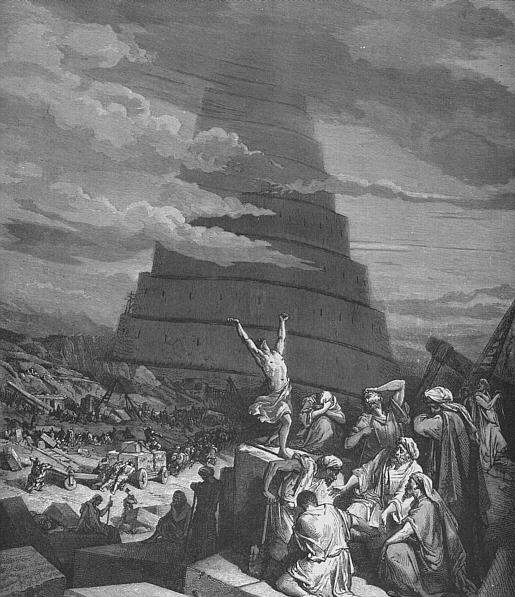
What did the tower look like?
Many artists of the past 500 years or so have attempted to picture what they thought the tower looked like.

Miguel Rodriguez

Paul Gosselin

Athanasius Kircher
 
Gustave Dore
 
An interesting description of the tower exists in the Jewish Book of Jubilees.  This book is a Jewish collection of writings that are considered pseudopigrapha by the Christian church in the west, but are considered scripture by the Eastern Christian church.  The writings were well known to the early church fathers, and 15 scrolls in the Dead Sea Scrolls are of the Book of Jubilees.

The Tower of Babel and the Confusion of Tongues (x. 18-27; cf. Gen. xi. 1-9).
18. And in the three and thirtieth jubilee, in the first year in the second week, Peleg took to himself a wife, whose name was Lômnâ the daughter of Sînâ’ar, and she bare him a son in the fourth year of this week, and he called his name Reu; for he said: "Behold the children of men have become evil through the wicked purpose of building for themselves a city and a tower in the land of Shinar."
19. For they departed from the land of Ararat eastward to Shinar; for in his days they built the city and the tower, saying, "Go to, let us ascend thereby into heaven."
20. And they began to build, and in the fourth week they made brick with fire, and the bricks served them for stone, and the clay with which they cemented them together was asphalt which cometh out of the sea, and out of the fountains of water in the land of Shinar.
21. And they built it: forty and three years were they building it; its breadth was 203 bricks, and the height (of a brick) was the third of one; its height amounted to 5433 cubits and 2 palms, and (the extent of one wall was) thirteen stades (and of the other thirty stades).
22. And the Lord our God said unto us: "Behold, they are one people, and (this) they begin to do, and now nothing will be withholden from them. Go to, let us go down and confound their language, that they may not understand one another's speech, and they may be dispersed into cities and nations, and one purpose will no longer abide with them till the day of judgment."
23. And the Lord descended, and we descended with Him to see the city and the tower which the children of men had built.
24. And He confounded their language, and they no longer understood one another's speech, and they ceased then to build the city and the tower.
25. For this reason the whole land of Shinar is called Babel, because the Lord did there confound all the language of the children of men, and from thence they were dispersed into their cities, each according to his language and his nation.
26. And the Lord sent a mighty wind against the tower and overthrew it upon the earth, and behold it was between Asshur and Babylon in the land of Shinar, and they called its name "Overthrow."
27. In the fourth week in the first year in the beginning thereof in the four and thirtieth jubilee, were they dispersed from the land of Shinar.

This record tells us that they built the tower for 43 years and that its size was impressive: 13 stades by 30 stades is 8,281 feet by 19,110 feet or 1.57 miles by 3.6 miles; its height of 5433 cubits is at least 8149 feet or 1.6 miles. 

Now, would you say that this is an impossible situation?  That the whole thing would crumble if it was that large?
  • In his book, Structures or why things don't fall down (Pelican 1978–1984), Professor J.E. Gordon considers the height of the Tower of Babel. He wrote, 'brick and stone weigh about 120 lb per cubic foot (2,000 kg per cubic metre) and the crushing strength of these materials is generally rather better than 6,000 lbf per square inch or 40 megapascals. Elementary arithmetic shows that a tower with parallel walls could have been built to a height of 2.1 km (1.3 mi) before the bricks at the bottom were crushed. However by making the walls taper towards the top they ... could well have been built to a height where the men of Shinnar [sic] would run short of oxygen and had difficulty in breathing before the brick walls crushed beneath their own dead weight."
Do you still think this is somewhat fantastic?  Unbelievable?  Here are some other historical records:
  • Gregory of Tours (I, 6) writing c. 594, quotes the earlier historian Orosius (c. 417) as saying the tower was "laid out foursquare on a very level plain. Its wall, made of baked brick cemented with pitch, is fifty cubits wide, two hundred high, and four hundred and seventy stades in circumference. A stade contains five agripennes. Twenty-five gates are situated on each side, which make in all one hundred. The doors of these gates, which are of wonderful size, are cast in bronze. The same historian Orosius tells many other tales of this city, and says: 'Although such was the glory of its building still it was conquered and destroyed.'"
  • A typical medieval account is given by Giovanni Villani (1300): He relates that "it measured eighty miles round, and it was already 4,000 paces high, or 5.92 km (3.68 mi) and 1,000 paces thick, and each pace is three of our feet." The 14th century traveler John Mandeville also included an account of the tower, and reported that its height had been 64 furlongs or 13 km (8 mi), according to the local inhabitants.
  • The 17th century historian Verstegan provides yet another figure - quoting Isidore, he says that the tower was 5,164 paces high, or 7.6 km (4.7 mi), and quoting Josephus that the tower was wider than it was high, more like a mountain than a tower. He also quotes unnamed authors who say that the spiral path was so wide that it contained lodgings for workers and animals, and other authors who claim that the path was wide enough to have fields for growing grain for the animals used in the construction.

But we really don't know for sure what the tower looked like or how large it was, just that its top was to reach to heaven and that it seems to have been completed or near completion.  However, we can make some deductions based on the language of the Old Testament.

The Hebrew word used here for "tower" is migdal.  It is also used to represent a pyramidal bed for planting flowers.  We can probably assume that the tower was a similar shape.  This shape appears all over the world in the form of the ziggurat, or stepped pyramid.


This is an artist's representation of a ziggurat still under construction.  Obviously, it is not as large as described in the records I've listed above!

Recently, scholars have discovered that a private collection of ancient manuscripts belonging to a Norwegian businessman named Martin Schoyen contains a stele in cuneiform text that describes a Babylonian tower called the Etemananki. 
  • Etemenanki (Sumerian: "temple of the foundation of heaven and earth") was the name of a ziggurat dedicated to Marduk in the city of Babylon. It was famously rebuilt by the 6th century BC Neo-Babylonian dynasty rulers Nabopolassar and Nebuchadnezzar II. According to modern scholars such as Stephen L. Harris, the biblical story of the Tower of Babel was likely influenced by Etemenanki during the Babylonian captivity of the Hebrews.
  • Nebuchadnezzar wrote that the original tower had been built in antiquity: "A former king built the Temple of the Seven Lights of the Earth, but he did not complete its head. Since a remote time, people had abandoned it, without order expressing their words. Since that time earthquakes and lightning had dispersed its sun-dried clay; the bricks of the casing had split, and the earth of the interior had been scattered in heaps." [source: Wikipedia]
 
In Nebuchadnezzar's own words:
  • The tower, the eternal house, which I founded and built. I have completed its magnificence with silver, gold, other metals, stone, enameled bricks, fir and pine. The first which is the house of the earth’s base, the most ancient monument of Babylon; I built and finished it. I have highly exalted its head with bricks covered with copper. We say for the other, that is, this edifice, the house of the seven lights of the earth the most ancient monument of Borsippa. A former king built it, (they reckon 42 ages) but he did not complete its head. Since a remote time, people had abandoned it, without order expressing their words. Since that time the earthquake and the thunder had dispersed the sun-dried clay. The bricks of the casing had been split, and the earth of the interior had been scattered in heaps. Merodach, the great god, excited my mind to repair this building. I did not change the site nor did I take away the foundation. In a fortunate month, in an auspicious day, I undertook to build porticoes around the crude brick masses, and the casing of burnt bricks. I adapted the ciruits, I put the inscription of my name in the Kitir of the portico. I set my hand to finish it. And to exalt its head. As it had been done in ancient days, so I exalted its summit.
This same tower was in the reconstruction plans of Alexander the Great about 300 years later.  He ordered it demolished to prepare for rebuilding, but his death interfered with the plans, and nothing more was said about this tower in antiquity.
 
Whether this tower, the Etemenanki was the Tower of Babel, or was another smaller, similar tower will never be known. 
 

Saturday, March 16, 2013

Biblical History of Man: The Flood to Babel part 4

Now we come to Nimrod.  Who was he?

Nimrod was the grandson of Ham.
Genesis 10  6 The sons of Ham were Cush and Mizraim and Put and Canaan. 7 The sons of Cush were Seba and Havilah and Sabtah and Raamah and Sabteca; and the sons of Raamah were Sheba and Dedan. 8 Now Cush became the father of Nimrod; he became a mighty one on the earth. 9 He was a mighty hunter before the Lord; therefore it is said, “Like Nimrod a mighty hunter before the Lord.” 10 The beginning of his kingdom was Babel and Erech and Accad and Calneh, in the land of Shinar. 11 From that land he went forth into Assyria, and built Nineveh and Rehoboth-Ir and Calah, 12 and Resen between Nineveh and Calah; that is the great city.

Nimrod means "we shall revolt/rebel".  It may not have been his given name, rather a derisive term or a type.  This is done in many places in scripture.  If so, it is possible that the name Nimrod was given to one of the five listed sons of Cush.  If not, then Nimrod was Cush's sixth son.

Josephus tells us:  He was bold, of great strenth.  He ascribed his power to himself, not to God.  He set up tyranny and sought vengeance on God for the flood.  He defied God.  He was the one who has credit for building the Tower of Babel.

Hebrew commentators emphasize that Nimrod was in opposition to the Lord.  He was a tyrant...a powerful hunter of men.  The Seder Olam (a Jewish timeline of scripture) says that Nimrod declared himself king in 1788 AM (2387 BC). 

Scripture tells us that his kingdom began in Babel, and Erech (Uruk) and Accad (Akkad) and Calneh in Shinar.  Later he went north into Assyria, and built Ninevah, Rehoboth, Calah, and Resen.  Archaeological records that correspond to this would give him the name of Ninus.

The Hebrew terminology that is used in Genesis 10:8 is particularly interesting.  It says that "he became a mighty one on the earth". 
  • "Mighty one" is gibborim. That word is used in Genesis 6:4 of the Nephilim.  It is used again in 1 Samuel 17:51 of Goliath, and is later used to describe David's mighty men. 
  • "Became" in this instance is chalal.  It means he profaned or desecrated himself in order to accomplish what he did.
In verse 9 scripture tells us that Nimrod was a "mighty hunter before YHWH".  The Hebrew text tells us clearly that Nimrod was in opposition to the Lord.  "Before" doesn't mean on God's side, marching triumphantly in front of Him in battle, but standing before Him, in His face in rebellion.

A final note: It is very probable that the Epic of Gilgamesh is the story of Nimrod.  Please read this interesting article about Nimrod.  Nimrod - Who was he?

Was he a giant?

Biblical History of Man: The Flood to Babel part 3

Now, I know that there is much conflict about the idea of giants.  Giant skeletons have been unearthed.  History records giants.  The Bible records giants. 

But man wants to deny it.  He wants to say that giants are just genetic mutations.  That may be true sometimes.  He wants to say that the pictures have been Photoshop-ed.  That may be true sometimes as well.  I'm just going to share some pictures.


As far as I am aware, the field pictures here are not modified. I am aware of some that were.  Two are pictures taken in museums.  One is a National Geographic photo from the 1920's.  Another is from the 1950's.  The last is a chart that shows skeletons on record world-wide, whether excavated or recorded, none of which allows for falsification.

Food for thought.